“When we opened our office back in 1990 and distributed pamphlets about our new cable business, people couldn’t believe that a mere antenna and VCR could bring movies to their televisions,” recalls Sunil Jolly, director of Den Enjoy Network, a Multi-System Operator (MSO) in Lucknow and one of the city’s earliest cable operators.
The excitement was high. But it was a new technology, and no trained workers were available.
To lay down wires, we would just ask around if anybody needed work—even rickshaw pullers were roped in.
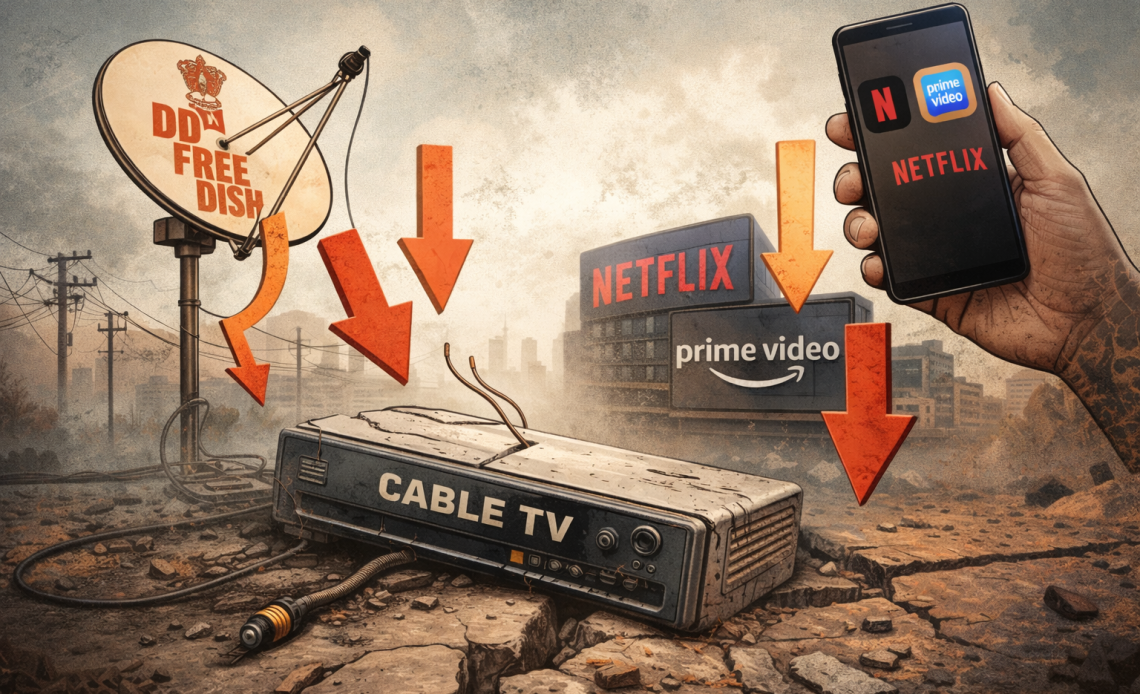
“Those days of glory are long gone now. First came DTH services, including the government-run free DTH option. Then YouTube, and ultimately OTT platforms. Cable TV subscriptions have nearly halved,” Jolly tells Invezz.
Cable TV decline amid OTT and streaming boom
As India’s mobile and internet subscriber base continues to surge, the linear cable TV industry has quietly receded.
Once the gateway to a wider world of entertainment—music channels like MTV, drama serials on Star Plus, and beyond the national broadcaster Doordarshan—cable TV’s dominance has eroded.
YouTube introduced Indians to global content on demand, while OTT platforms offered virtually unlimited high-quality programming.
As a result, demand for pay TV—including cable and Direct-to-Home (DTH) services—has declined sharply, with tier 1 cities seeing the steepest drops. In smaller towns, the government-run DD Free Dish, a free DTH service, is capturing market share.
The trend mirrors a global shift from cable to streaming and free over-the-air TV, commonly called “cord-cutting.”
In the US, pay-TV providers have lost roughly 25 million subscribers over the past decade.
Pay TV subscriber losses: data from India
According to the “State of Cable TV Distribution in India” report by EY and the All India Digital Cable Federation (AIDCF), pay TV subscribers fell from 151 million in 2018 to 111 million in 2024.
An online survey of 28,000 local cable operators (LCOs) by EY and AIDCF found that 93% reported a drop in monthly take-home income since 2018.
Almost half said their subscriber base declined, with nearly 10,000 reporting losses exceeding 40%.
With an estimated 85,000 LCOs in India, the decline has had a major employment impact.
The fall of 40 million pay-TV households between 2018 and 2024 resulted in roughly 37,835 job losses among the surveyed 28,181 LCOs.
Extrapolated nationwide, total job losses range from 114,000 to 195,000, the report notes.
Key challenges cited by LCOs include the inability to raise collections with rate hikes, a decline in second-TV homes, migration to OTT and connected TV, and superior digital content quality.
Consumer shift to smart TVs and streaming packages
“I think a few years ago we moved to a smart TV, which allowed both cable and streaming channels,” says Samata Das, a professional in Berlin, describing her home set-up in Bhubaneswar, Odisha.
The streaming content was more interesting. Then our internet provider offered a comprehensive package—high-speed internet for work from home, streaming channels, and a basic cable package. Now we pay one bill for Wi-Fi, OTT, and some cable channels. It’s ultimately a matter of convenience.
How DD Free Dish is eating into pay TV market share
The decline in pay TV did not happen overnight.
In Uttar Pradesh, India’s most populous state with around 240 million residents, one major disruption was the government’s free DTH service.
DD Free Dish, owned by public broadcaster Prasar Bharati, launched in December 2004 as India’s only free-to-air DTH platform.
It charges no monthly subscription; access requires a one-time investment of roughly Rs 2,000 for a set-top box and dish antenna, making it one of India’s most affordable television services.
Today, it has grown into the largest DTH platform in the country.
Source: State of Cable TV Distribution in India report
Free TV subscriber growth: DD Free Dish leads the way
According to an EY report, free TV subscribers in India rose from 33 million in 2017 to 49 million in 2024.
However, The Economic Times cites other agencies suggesting the actual number is significantly higher.
Delhi-based Chrome DM estimates the base has already crossed 60 million homes—surpassing the combined subscribers of all pay DTH operators, which stand around 57 million, the ET report noted.
Sunil Jolly points to DD Free Dish as the biggest disruption to cable TV and DTH services, particularly in the Hindi-speaking belt.
“UP has taken a big beating since the consumer base in the state is extremely price-sensitive,” he says.
Bharat Ranga, MD of Beginnen Media, concurs.
“The actual base of DD Free Dish is unknown since it’s unencrypted, and even Prasar Bharati doesn’t have precise numbers. Yet, it has emerged as India’s leading TV distribution platform, with its core in the Hindi heartland and growing presence in new regions, including cities and metros,” Ranga told The Economic Times.
While channels on Free Dish—such as Star Utsav, Colors Rishtey, and Zee Anmol—mostly air reruns, for subscribers, the content is effectively new.
A FICCI-EY report projects free TV, led by DD Free Dish, will grow from 49 million homes in 2024 to 57 million by 2030, though it notes there is no precise measurement method for the segment.
How Covid-19 accelerated cable TV’s decline
The pandemic dealt another blow to the industry. Months-long lockdowns forced commercial establishments—shops, eateries, and hotels—to close, severing their TV connections and cutting revenue for operators.
“Even a pan-seller or a barber’s shop had a small TV in their shop,” Jolly recalls.
Schools and universities shifting to online classes further hastened the decline.
“When classes became online, every household had to get a broadband connection. This made it easier for them to access content on platforms like YouTube and OTT channels,” he adds.
Broadband adoption surged from 6.1 crore (61 million) connections in March 2014 to 99.56 crore (995.6 million) in September 2025—a growth of over 1,500%.
Even after lockdowns ended, many commercial establishments struggled financially, making it difficult to maintain cable subscriptions.
“Now, you see every shopkeeper peering into his mobile phone,” Jolly observes.
Regulatory changes and their impact on cable TV
Cable TV’s struggles were also influenced by policy shifts.
The Tariff Order of 2017, along with Interconnection & QoS Regulations, established a framework for pricing, allowing customers to select individual channels (à la carte) or bundles.
Narender Bagri, president of the All Local Cable Operators Association of India, explains the impact:
Earlier, bundling cost the customer around Rs 200 per TV. Under the new rules, the cost rose to Rs 500–600 per TV, leading households to limit cable access to a single set, instead of multiple TVs as before.
Broadband as a lifeline for local cable operators
With cable TV revenues declining, many operators have turned to broadband services to sustain their businesses.
The EY report notes that 43% of surveyed LCOs had already launched broadband offerings, though results varied due to competition from large ISPs and telcos with bigger marketing budgets.
Another 20% of respondents were considering broadband, but experts caution that it is not a straightforward pivot.
Jolly, who expanded into broadband years ago, says early movers had an advantage, but the model is not feasible for all.
Not everybody could do it, maybe less than 10% could succeed, mostly because they couldn’t secure enough subscriptions. You also have to consider competition from Airtel, Jio, and the likes.
Source: State of Cable TV Distribution in India report
Broadband adoption faces regulatory and compliance hurdles
Rajesh Chharia, president of the Internet Service Provider Association of India, who also runs broadband services in Ghaziabad and Noida, explains the challenges.
“Cable TV operators could have and should have distributed broadband more effectively to reach every nook and corner. But the same story playing out in the cable TV business is repeating itself in broadband,” he tells Invezz.
Chharia notes that ISPs use the UL ISP & UL ISP VNO (Virtual Network Operator) license, which allows reselling internet service by leasing bandwidth from major telecom operators without owning physical infrastructure.
It is a small license, and the government has reduced the entry fee, but compliance requirements have increased significantly. It’s not easing business—it’s increasing the cost of compliance.
“It is not easy for small providers. The compliance load is so high that many immediately want to surrender their licenses. Whether a small ISP with a category C license or a large TELCO with a category A license, compliance demands are similar. Large operators have thousands handling it, while small operators often have just one person managing sales, paperwork, and technical support,” he adds.
“Currently, an ISP has to submit around 165 reports per year, and the number keeps growing,” he says.
Chharia also highlights market pressures:
“With bigger players controlling pricing, smaller operators merely survive by matching rates, not by saving or generating real profit.”
IPTV emerges as an alternative to cable
IPTV, or Internet Protocol Television, delivers TV content over the internet and offers an alternative to traditional cable and satellite services.
Earlier this year, Bharti Airtel rolled out IPTV across more than 2,000 cities, while Delhi-based provider Excitel aims to onboard 2 million users by next year.
By bundling live TV channels with OTT subscriptions in a single package, these providers target cable TV households that have yet to fully shift to streaming.
Sanjiv Shankar, additional secretary at the Ministry of Consumer Affairs and former joint secretary at the Ministry of Information and Broadcasting, highlighted the trend at the EY-AIDCF report launch.
He said convergence in the industry and MSOs moving into IPTV is a “natural progression” to ensure long-term sustainability.
About 37% of respondents in the EY-AIDCF survey are actively exploring this shift.
Will cable TV survive in India?
With multiple competitors limiting growth, questions arise about the future of cable TV.
According to the EY-AIDCF report, while the total number of TVs in India is projected to reach 214 million by 2030, pay TV is expected to decline by 30–40 million households, driven by Connected TVs and Free TV.
However, ICRA suggests cord-cutting in India will be moderate due to price sensitivity.
“Despite a large subscriber base, Indian TV distribution lags markets like the US and Europe, where ARPU is higher. In developed markets, consumers pay for premium content like HD sports, while India and China maintain lower ARPU due to price sensitivity. Coupled with a tradition of TV viewing and hybrid offerings, this will prevent a sharp fall in pay-TV subscriptions,” says Ritu Goswami, sector head at ICRA.
Sunil Jolly agrees, noting the market has likely “bottomed out” and is unlikely to shrink further, though complete eradication is improbable.
He also points out why cable TV remains preferred:
“The channel swapping feature is unique. If someone wants news, they can switch between multiple channels without leaving the application, which can be cumbersome on other platforms.”
Cable providers also maintain a long-standing rapport with customers.
Shankar downplays the idea that digital is overtaking linear TV: “People like me watch both. We use linear and digital side by side. That’s the reality.”
He adds that price sensitivity ensures cable will not disappear:
Even with cheap data, watching digital content costs Rs 700–1,500 monthly in urban areas. Cable is far more cost-effective, and that matters in a price-sensitive market.
Government interventions and industry initiatives
As detailed earlier in the report, the fact that Linear TV is heavily regulated while its competitors stay outside the regulatory ambit created an uneven playing field.
“It is pertinent to note that Linear TV is heavily regulated, while its competitors, such as OTT Platforms, Connected TV, and DD Free Dish, are functioning freely outside the regulatory ambit. The level playing field has been disturbed on account of non-regulation of the other existing platforms,” the office of All India Digital Cable Federation (AIDCF) tells Invezz in an emailed response.
AIDCF thus outlines steps that can help the sustenance and growth of the cable TV industry:
1) FAST Platforms, Digital DPOs and Internet-based online applications should be covered under the definition of Broadcasting as they are also broadcasting content like Linear TV. These platforms ought not to be given exemption from regulatory compliance merely because the technology they use is different from Linear TV. Hence, same rules should apply to all platforms that are offering the same service.
2) Permitting differential Pay TV pricing for different territories based on their ability to pay.
3) Create adequate window before moving pay TV content onto free digital platforms.
4) Providing hardware and other subsidies and incentives to cable dark areas to adopt television. There are 330 million households in India, out of which 190 million are TV households.
Moreover, Narender Bagri, president of All Local Cable Operators Association of India, in an interaction with Invezz, talks about some initiatives like Dish TV’s “Own Your Customer” (OYC) initiative- a program empowering LCOs to directly manage and retain their subscribers.
The initiative lets LCOs sell and manage Dish TV services in their local areas, helping them strengthen their business and retain customers moving to DTH.
Bagri says already 600-700 LCOs have partnered with Dish TV for this initiative, and this has led to Dish TV’s subscriptions increasing by about 30,000 in the last 1-1.5 months.
The post As India cuts the cord, can cable television survive streaming wars in 2026? appeared first on Invezz