The United States has announced a sweeping naval blockade targeting Iranian-linked shipping in the Strait of Hormuz, marking a significant escalation in the conflict after peace talks over the weekend failed to produce a breakthrough.
President Donald Trump said on Sunday that the US Navy would begin blocking vessels entering or leaving Iranian ports, signalling a departure from earlier efforts that had sought to balance military pressure with stability in global energy markets.
“Effective immediately, the United States Navy, the Finest in the World, will begin the process of BLOCKADING any and all Ships trying to enter, or leave, the Strait of Hormuz,” Trump said in a social media post.
He added that the measure could eventually transition into a system where “ALL BEING ALLOWED TO GO IN, ALL BEING ALLOWED TO GO OUT,” depending on progress in negotiations.
The move comes after more than a month of escalating disruption in the strait, where Iranian actions—including attacks on vessels and threats of mined waters—have effectively choked off one of the world’s most critical maritime routes.
A chokepoint with global consequences
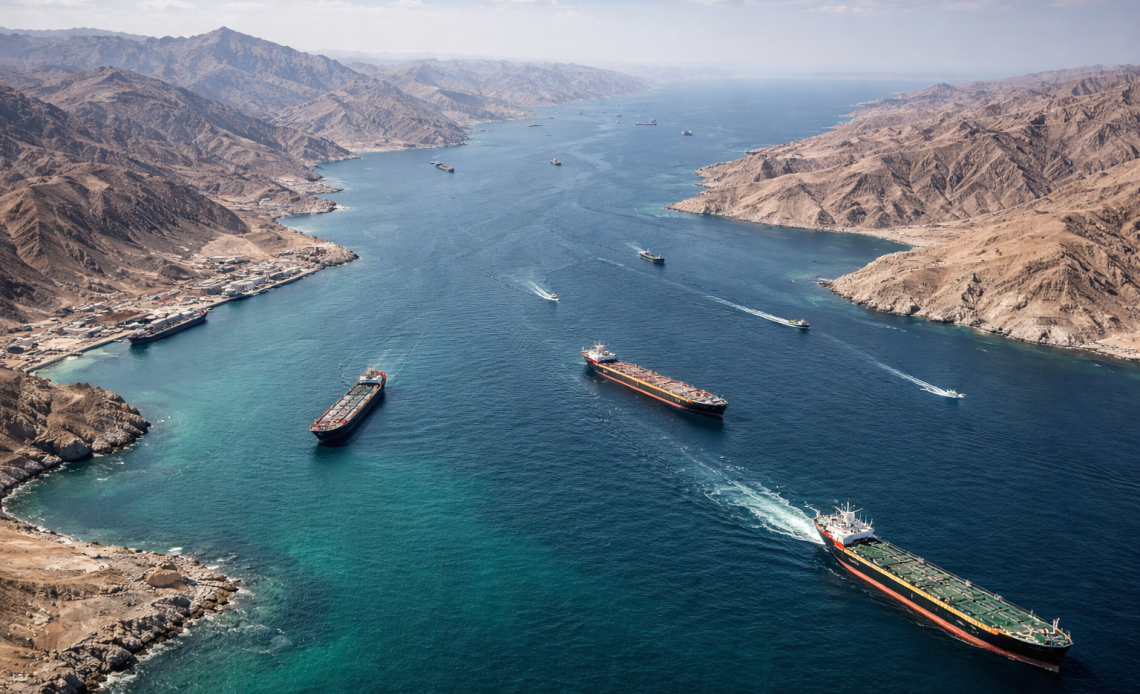
The Strait of Hormuz has long been regarded as one of the most strategically vital shipping lanes in the world.
It carries roughly one-fifth of global seaborne oil and significant volumes of liquefied natural gas, making it central to energy security across Asia, Europe and beyond.
Before hostilities intensified in late February, around 150 vessels transited the waterway daily.
By March, that number had dropped dramatically, with only slightly more than 150 ships passing through over the entire month, according to shipping intelligence data.
Iran has exercised considerable control over the strait during the conflict, allowing limited passage while leveraging its position to exert pressure on the United States and its allies.
Some vessels that did transit are believed to have done so under arrangements with Iranian authorities, potentially involving fees or tolls.
The blockade, to be enforced by United States Central Command, is set to begin Monday at 10 a.m. Eastern Time.
Officials said the US would not impede vessels transiting to or from non-Iranian ports, though all ships may be subject to inspection.
Parties at war can exercise the right of “visit and search,” meaning that they can stop and inspect even private vessels in waters that are not neutral and decide whether or not they may pass, said James Kraska, a professor of international maritime law at the US Naval War College and a visiting professor at Harvard Law School in a New York Times report.
Targeting Iran’s economic lifeline
At the heart of the blockade strategy is an effort to restrict Iran’s ability to export oil, a key source of revenue for its economy and military operations.
Analysts say such a move could have significant economic consequences for Tehran.
Robin Brooks of the Brookings Institution argued that cutting off oil exports could “collapse Iran’s business model,” given the country’s heavy reliance on energy revenues.
The decision represents a reversal of earlier US policy during the conflict.
Even as tensions escalated, Washington had taken steps to allow Iranian oil to continue flowing in order to prevent a sharp spike in global energy prices.
US officials had temporarily eased restrictions on Iranian shipments and permitted tankers to traverse the strait.
The shift toward a blockade suggests that the US is now prioritising strategic pressure over short-term market stability.
However, the move could create complications for countries that depend on Iranian oil, particularly China, which may face supply disruptions.
Iranian officials have sought to frame the blockade as counterproductive.
Mohammad Bagher Ghalibaf, Iran’s parliamentary speaker, warned that the measure could drive fuel prices higher, telling consumers to “enjoy the current pump figures” before conditions worsen.
Oil markets brace for further shocks
The disruption in the Strait of Hormuz has already had a profound impact on global energy markets, with oil prices rising sharply amid constrained supply.
A full blockade could intensify these pressures.
“Taking more oil off the market — particularly the only oil that is now getting out from the Persian Gulf — will drive oil prices further up … [to] around $150 per barrel,” Trita Parsi, executive vice president of the Quincy Institute for Responsible Statecraft, said on CNBC’s “The China Connection” on Monday.
Such a scenario would have far-reaching implications for inflation and economic growth.
Higher energy costs would ripple through supply chains, increasing the price of goods ranging from transportation to food.
The impact extends beyond crude oil.
The strait is also a key route for other commodities, including fertilizers and helium.
Besides crude, commodity prices for fertilizer and helium — critical inputs for food production and semiconductor manufacturing — are likely to keep climbing, fanning inflation that is already accelerating, said Ben Emons, managing director at Fed Watch Advisors.
Global institutions, including the International Monetary Fund and the World Bank, have already signalled concerns, warning that the crisis could lead to slower growth and higher inflation, particularly in emerging economies.
Operational and enforcement challenges
While the blockade represents a bold strategic move, its implementation is likely to face significant hurdles.
Shipping intelligence firms have pointed to the widespread use of evasive tactics such as Automatic Identification System spoofing, which allows vessels to disguise their locations and movements.
Some Iran-linked tankers have reportedly used false port calls in neighbouring countries to circumvent restrictions.
Tanker Trackers, a maritime monitoring firm, warned that enforcement could prove difficult in such an environment, noting that attempts to regulate vessel traffic could be undermined by deceptive practices.
There are also security risks to consider.
Iran retains the capability to deploy naval mines, missiles and drones, raising the possibility of further escalation in the region.
Retired US Navy admiral James Stavridis expressed support for the blockade, arguing that it corrects an imbalance that had allowed Iran to benefit disproportionately from restricted shipping.
“In recent days,” he wrote, “the ONLY people benefiting from Gulf transit were the Iranians.”
He said that the United States and its allies “are no worse off than we were after the Iranians started holding the Strait hostage.”
Global economy on edge
The prolonged disruption in the Strait of Hormuz has already raised alarms among economists and policymakers.
Some analysts have drawn comparisons to the 1970s oil crisis, when supply shocks led to soaring prices and widespread economic disruption.
The current situation has similarly strained global supply chains, affecting industries ranging from energy to manufacturing.
Higher transportation costs and supply shortages are feeding into inflation, complicating efforts by central banks to stabilise prices.
Emerging markets are particularly vulnerable, given their reliance on imported energy and limited capacity to absorb higher costs.
“The economic scarring from attacks on energy facilities and ports in Iran and other Gulf nations could continue to keep supply under stress in emerging Asia,” Barclays said.
“It remains to be seen how quickly the extraction, refining, and loading of oil and gas can be normalized.”
The post US Hormuz blockade: rationale, execution and impact on oil appeared first on Invezz