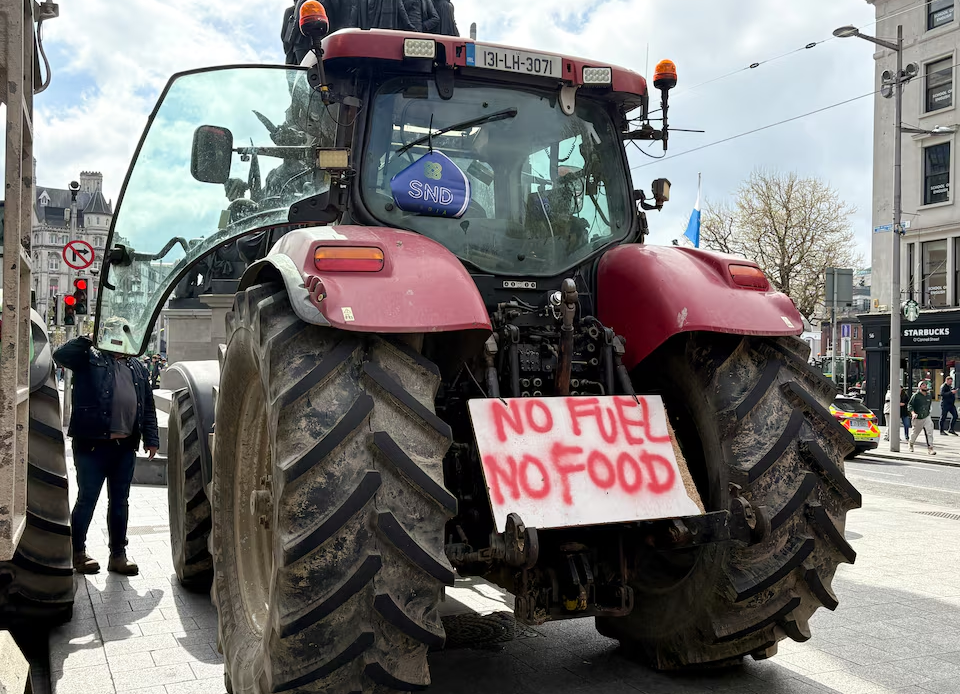
Protests over rising fuel prices in Ireland have entered their fourth consecutive day, triggering widespread disruption across the country
Demonstrators have blockaded three of Ireland’s primary refineries and fuel terminals, leading to supply shortages and bringing traffic in Dublin to a standstill.
The protests have been largely driven by farmers, agricultural contractors, and road haulage operators.
These groups have voiced strong dissatisfaction with the government’s response to the sharp rise in fuel costs following the onset of the Iran war.
Despite the scale of the demonstrations, major industry organisations such as the Irish Farmers’ Association and the Irish Road Haulage Association have not formally endorsed the protests.
Global energy pressures add to domestic strain
Ireland’s unrest comes amid broader global challenges linked to rising fuel prices.
Countries worldwide are grappling with energy market volatility stemming from the Middle East conflict.
In the United Kingdom, Prime Minister Keir Starmer expressed frustration with fluctuating energy costs, stating he was “fed up” with bills being affected by decisions involving US President Donald Trump and Russian President Vladimir Putin.
Meanwhile, oil prices showed some moderation on Friday after previously reaching highs, although shipping flows through the Strait of Hormuz remain significantly restricted, adding to ongoing uncertainty in global energy markets.
Fuel shortages worsen as blockades continue
The impact of the protests has been felt acutely at petrol stations across Ireland, many of which have run out of fuel.
Protesters have indicated they intend to maintain their blockades until they secure a meeting with government officials to discuss their concerns, particularly what they describe as insufficient support measures.
The Irish government has responded by placing the army on standby to potentially assist in clearing blockades at critical infrastructure points.
Taoiseach Micheál Martin strongly criticised the demonstrations, describing them as an “act of national sabotage,” and questioning the rationale behind restricting fuel access during a period of already elevated prices.
Government measures and policy response
In March, the Irish government introduced a €250 million support package aimed at easing the burden of rising fuel costs on households and businesses.
The measures included reductions in excise duties on petrol and diesel.
At the time, Finance Minister Simon Harris acknowledged the uncertainty surrounding the situation, stating, “We will navigate this period of volatility.
But, to put it bluntly, nobody knows what the situation will be in a month from now; we must remain flexible in our response.”
Government officials are scheduled to meet with industry representatives to address the ongoing crisis.
However, Defense Minister Helen McEntee confirmed that the protesting groups have not been invited to participate in these discussions, potentially complicating efforts to reach a resolution.
In response to the wider energy shock, governments across Europe have implemented various measures to cushion the impact.
These include export restrictions, regulatory adjustments, and consumer protection policies.
The UK has introduced requirements for heat pumps and solar panels in new homes, while Greece has imposed temporary caps on fuel and supermarket profit margins.
As Ireland’s protests continue, the situation underscores the growing tension between rising global energy costs and domestic policy responses, with no immediate resolution in sight.
The post Fuel protests disrupt Ireland as Iran war sparks price shock appeared first on Invezz