
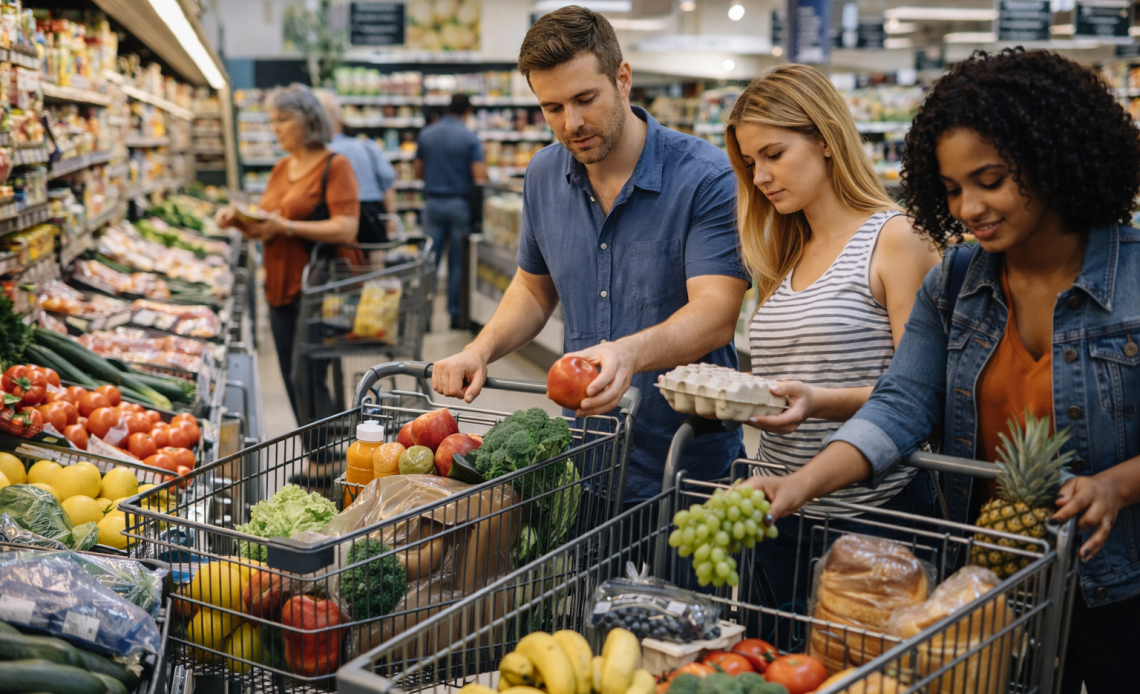
Rising grocery prices in the United States, driven by the ongoing Iran conflict, are emerging as a potential political flashpoint ahead of critical midterm elections, with both parties positioning their messaging around affordability and economic impact.
The war and the closure of the Strait of Hormuz have disrupted global supply chains, pushing up oil, gasoline, and fertilizer prices.
Economists warn that these pressures could soon translate into higher food costs for consumers, compounding an already sensitive issue for voters.
Two years earlier, Donald Trump secured reelection by focusing heavily on rising grocery prices.
Now, his administration faces the prospect of renewed food inflation as Republicans seek to maintain control of Congress.
Political stakes rise with food prices
Democrats are aiming to link rising costs directly to the administration’s foreign policy decisions, framing the issue as one of affordability and accountability.
“Our messaging is affordability and accountability,” Rep. Jared Huffman said in a CNBC report. “It’s a pretty tailored message, pretty narrowly focused, and on both of those pillars, Trump is making our arguments even more compelling.”
“There are a number of ways in which this president is driving up food and energy costs and fueling the affordability crisis,” Huffman said. “On all of these fronts, we would have a chance to rein in the craziness. I really think it sets up in a very compelling way for Democrats in this election.”
Republicans, meanwhile, have acknowledged the potential economic impact while downplaying the likelihood of prolonged disruption.
“I think any disruption in terms of the transportation of feedstocks, of inputs, any restriction, could certainly wind up impacting the consumer,” said Rep. G. T. Thompson. “That’s pretty obvious.”
Supply chain pressures build
The closure of the Strait of Hormuz has triggered a cascade of cost increases across the food supply chain.
Higher oil prices are raising diesel costs, which are essential for farm operations and the transportation of goods. Fertilizer supplies have also been constrained, further increasing production costs.
Economists suggest these factors will likely be passed on to consumers over time. “The price of food is going to move quite a lot,” said Kjetil Storesletten, an economist at the University of Minnesota and director of the Heller-Hurwicz Economics Institute.
“If you put those things together, that it’s a big chunk of the price of producing food and that the price increased a lot, it suggests that all of the increased price in fertilizer is going to be passed through to food.”
The timing of these pressures means the full impact may not be immediate. Current grain supplies are unaffected, but crops being planted now will reflect higher input costs later in the year.
“The amount of grain on the market now is unaffected by the price of gas and the price of fertilizer,” Storesletten said. “But for the new corn and the new grain that gets planted, it’s going to matter.”
“It would really help if we could open the Strait of Hormuz now. But imagine it remains closed until the summer. We will see substantial increases in food prices,” Storeslettsen said.
Inflation risks and election outlook
Food inflation has remained a persistent concern for US consumers.
In February, it stood at 3.1%, above the overall inflation rate of 2.4%, reflecting the sector’s sensitivity to external shocks such as weather, supply disruptions, and input costs.
The current situation draws parallels to previous election cycles, when rising food prices played a decisive role in shaping voter sentiment. Now, both parties are closely watching how the conflict and its economic fallout evolve in the months leading up to November.
While some Republicans remain hopeful that the impact will be temporary, options to mitigate rising costs appear limited. President Trump indicated that reopening the Strait of Hormuz may depend on broader international efforts.
“The countries of the world that do receive oil through the Hormuz Strait must take care of that passage,” he said. “They can do it easily. We will be helpful, but they should take the lead in protecting the oil that they so desperately depend on.”
The post Iran war risks grocery price surge, fueling US election tensions appeared first on Invezz